Employee Onboarding Automation Malaysia: An SME Guide
Employee onboarding automation in Malaysia helps SMEs collect new-hire documents on WhatsApp, check EPF, SOCSO and tax details, and get staff working sooner.
You finally found the right person. The offer is signed, the start date is set, and then the real work begins. Someone in HR or admin has to chase a copy of the IC, a bank account number, EPF and tax details, an emergency contact and a signed policy acknowledgement. Half of it arrives as blurry photos in a WhatsApp chat. The other half arrives on day one, or the week after. Meanwhile the new hire sits at a desk with no laptop login, and payroll is waiting for details that are still in somebody's phone.
For a Malaysian SME without a full HR department, onboarding is not a strategy problem. It is an admin problem. This guide explains what employee onboarding automation actually does, which steps are worth automating first, where a human should stay in control, and how an AI HR agent fits in without replacing the HR system you already use.
What Is Employee Onboarding Automation?
Employee onboarding automation is the use of software to handle the repetitive steps between "offer accepted" and "new hire is fully set up". Instead of HR manually sending checklists, chasing missing documents and retyping details into spreadsheets and payroll, an automated workflow does the chasing, collecting, checking and recording, then hands a clean, complete file to a person for sign-off.
Traditional onboarding software is usually a portal: the new hire logs in, uploads files and ticks boxes. That works well for large companies with tech-savvy candidates. Many Malaysian SMEs hire for roles where a new portal login is one more barrier, and where the natural channel is already WhatsApp.
An AI HR agent takes a different approach. It works where your new hires already are:
- It sends the onboarding checklist in a chat and explains each item in plain language.
- It reads the documents and photos that come back, and pulls out the details HR needs.
- It flags anything missing, unclear or inconsistent, and follows up on its own.
- It updates your HR records or payroll sheet, then asks a human to review before anything is final.
Why Onboarding Is Still Manual for Most Malaysian SMEs
If onboarding is so repetitive, why is it still done by hand in so many businesses? A few reasons come up again and again.
Hiring is irregular. Some months bring several hires, others none, so each onboarding is handled from scratch.
The documents arrive in every format. Photos of an IC, a screenshot of a bank statement header, a scanned certificate, a PDF offer letter signed on a phone. Someone has to open each one, read it and type the details somewhere.
Statutory registrations need care. Malaysian employers need the right details to register new staff with KWSP (EPF), PERKESO (SOCSO and EIS) and to set up monthly tax deductions (PCB) with LHDN. Getting a number wrong creates problems later, so HR double-checks everything manually.
Information lives in too many places. The offer letter is in email, the documents are in WhatsApp, the employee list is in a spreadsheet, and payroll is in another system. Every handover between them is a chance for something to slip.
The person who does it is busy with everything else. In many SMEs, onboarding is handled by an admin executive or the owner, on top of their real job. When they are on leave, onboarding simply waits.
None of these problems need a new HR system. They need reliable chasing and data entry.
What You Can Automate in the Onboarding Process
Not every onboarding step should be automated, but most of the admin around it can be. Here are the steps SMEs typically hand over first.
Pre-boarding document collection
Once an offer is accepted, the agent sends a welcome message and a checklist of what is needed before day one. It collects each item in the same chat, confirms what has been received, and reminds the new hire about anything still outstanding. HR no longer has to scroll through chats to see who has sent what.
Reading and checking documents
Using OCR and vision AI, the agent extracts the key details from IC copies, bank details, certificates and forms. It checks that names match across documents, that required fields are filled, and that nothing obvious is missing. Anything unclear goes back to the new hire with a specific request, or to HR for a decision.
Statutory and payroll details
The agent gathers the information HR needs for EPF, SOCSO, EIS and PCB setup, and records it in the right place. It does not make compliance decisions for you. It makes sure HR has complete, consistent details in one place before they register the employee or update payroll.
HR records and payroll sync
Instead of retyping, the agent updates your employee records, whether that is a Google Sheet, a shared drive folder or your existing HR or payroll software. Each new hire gets a complete, organised file.
Day-one information and policy acknowledgements
The agent can share the day-one schedule, reporting time, dress code, leave policy and other handbook basics, answer common questions from your approved policy documents, and record when the new hire has acknowledged them.
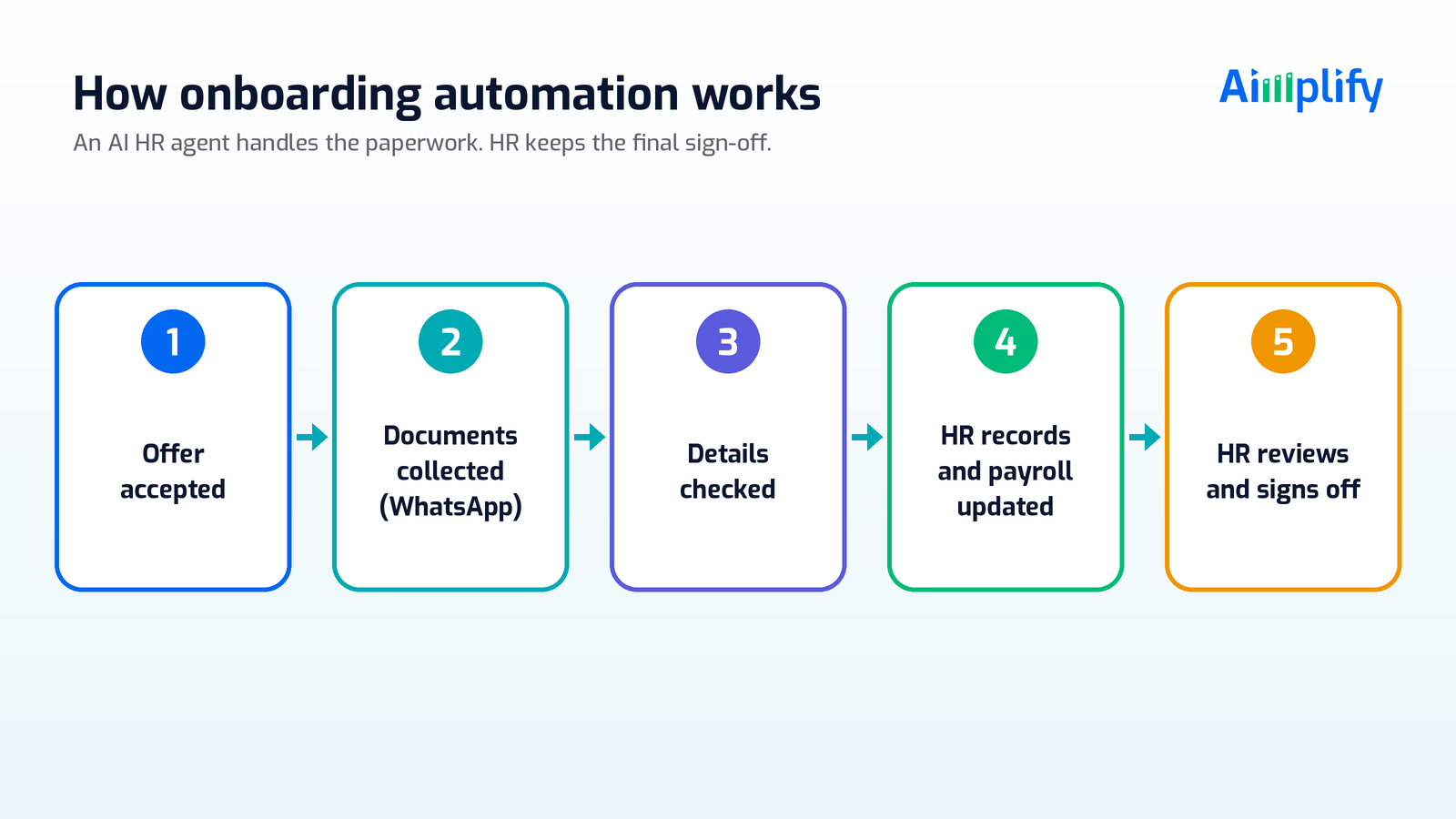
How an Automated Onboarding Workflow Works
Here is what a typical automated onboarding flow looks like for a small Malaysian business.
- Offer accepted. HR marks the candidate as hired, or forwards the signed offer letter. This starts the workflow.
- Welcome and checklist. The AI HR agent messages the new hire on WhatsApp with a short welcome and the list of documents and details needed.
- Documents collected. The new hire sends photos and files in the chat. The agent confirms each item and follows up on anything missing, at sensible hours.
- Details checked. The agent extracts the details, checks them for consistency and flags anything that needs a human look.
- Records and payroll updated. Verified details go into your HR records and payroll sheet or system, ready for statutory registration and the first payroll run.
- HR reviews and signs off. A person reviews the completed file, makes the final call on anything flagged, and confirms the new hire is ready to start.
Keep Humans in Control: Privacy, Approvals and the Personal Touch
Onboarding involves personal data, so automation has to be set up carefully.
Protect personal data. IC copies, bank details and contact information are personal data under Malaysia's Personal Data Protection Act 2010 (PDPA). Collect only what you need, tell new hires why you need it, store it in access-controlled locations and agree with your provider on how data is handled and retained.
Keep approvals with people. The agent prepares and checks. HR approves. Final decisions on employment terms, statutory registration and payroll should always have a human sign-off.
Know your obligations. Requirements and timelines for EPF, SOCSO, EIS and PCB are set by KWSP, PERKESO and LHDN. Use their official guidance, or your payroll adviser, as the source of truth. Automation helps you meet those requirements consistently; it does not replace them.
Keep the welcome human. Automating paperwork frees time for what matters: a manager's welcome, team introductions and a clear first week.
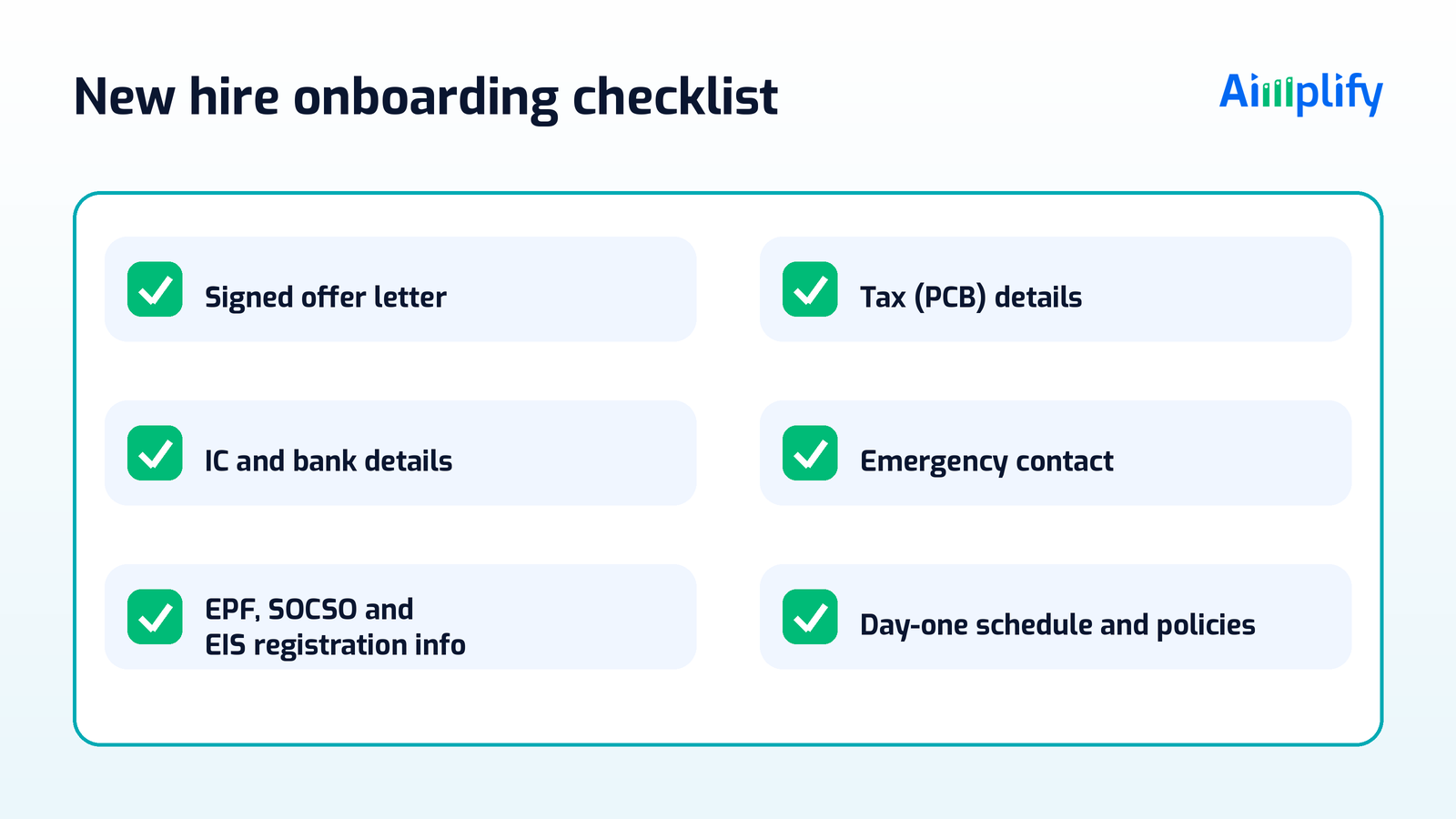
A New Hire Onboarding Checklist You Can Start With
If you are not ready to automate yet, start by standardising. Agree on a single checklist that every new hire goes through. A simple version for Malaysian SMEs:
- Signed offer letter or employment contract
- IC copy and bank account details for salary
- Details needed for EPF, SOCSO and EIS registration
- Tax details for PCB (monthly tax deduction) setup
- Emergency contact
- Day-one schedule, key policies and acknowledgement
Once the checklist is written down, it becomes the script your AI HR agent follows, and the standard every onboarding is measured against.
Where Aimplify HR Fits
Aimplify HR is an autonomous AI agent for the HR admin that slows Malaysian SMEs down. It covers the hiring journey from resume screening and candidate chats on WhatsApp or the web, through interview scheduling, to onboarding documents, leave and payroll sync, with EPF and SOCSO compliance tracking in mind.
If you are already using AI to shortlist candidates, onboarding is the natural next step. Our guide to AI resume screening in Malaysia covers the front end of the hiring process; onboarding automation picks up the moment the offer is accepted.
Aimplify works with the tools you already have. We do not ask you to rip out your current HR or payroll software. Data cleaning and integration with tools such as WhatsApp, email, Google Sheets and cloud drives are part of the setup, and our 28-day AI implementation plan shows how we take a workflow from bottleneck to go-live. The same approach powers Aimplify Accounting and Aimplify CS.
Ready to hire your AI workforce? Book a live demo or talk to an AI architect about automating onboarding in your business.
Frequently Asked Questions
What is employee onboarding automation?
Employee onboarding automation uses software to handle the repetitive steps after a job offer is accepted: sending checklists, collecting documents, checking details and updating HR records. HR still reviews and approves, but no longer has to chase paperwork or retype data by hand.
Can onboarding be done through WhatsApp in Malaysia?
Yes. An AI HR agent can send the checklist, collect documents and photos, answer common questions and send reminders through WhatsApp, which most Malaysian new hires already use. Sensitive details should be stored securely and handled in line with the PDPA.
Does automation handle EPF, SOCSO and PCB registration?
Automation gathers and checks the details HR needs for EPF, SOCSO, EIS and PCB setup and records them in one place. The registration decisions and submissions should stay with HR or your payroll adviser, following official KWSP, PERKESO and LHDN guidance.
Do I need a new HR system to automate onboarding?
No. An AI HR agent can work with what you already use, such as WhatsApp, email, Google Sheets, cloud folders and your existing payroll or HR software. The aim is to connect your current tools, not replace them.
Is onboarding automation only for large companies?
No. SMEs often benefit most, because onboarding is usually handled by one busy admin person or the owner. Automating the chasing and data entry makes every hire consistent, even when hiring is irregular or the usual person is on leave.
Related Articles
Lead Follow-Up Automation Malaysia: Reply on WhatsApp Fast
Lead follow-up automation in Malaysia helps SMEs reply to every WhatsApp enquiry fast, qualify leads, send timely follow-ups and pass hot leads to sales.
AI WorkforcePayroll Automation Malaysia: Faster, Accurate Pay Runs
Payroll automation in Malaysia helps SMEs gather attendance, leave and claims, prepare EPF, SOCSO, EIS and PCB, and run accurate pay without spreadsheets.
AI WorkforceAppointment Booking Automation Malaysia: Book on WhatsApp
Appointment booking automation in Malaysia lets SMEs take bookings on WhatsApp 24/7, confirm slots, send reminders and handle changes without extra admin.