Payment Reminder Automation Malaysia: Get Paid on Time
Payment reminder automation in Malaysia helps SMEs send polite WhatsApp and email reminders for overdue invoices, track payments and update the books faster.
It is the second week of the month. Payroll is coming, suppliers want to be paid, and your bank balance does not match the sales you made. The money is out there, sitting in invoices that customers have not settled yet. Somebody needs to chase them, but the person who usually does it is also handling claims, bank reconciliation and the next round of invoices. So the reminders go out late, or not at all, and the same few customers keep paying 30, 60 or 90 days after the due date.
For most Malaysian SMEs, slow collection is not because customers refuse to pay. It is because nobody follows up consistently. This guide explains what payment reminder automation actually does, how a reminder workflow works from invoice to receipt, how to keep the tone right for Malaysian business relationships, and where an AI accounting agent fits without replacing the accounting software you already use.
What Is Payment Reminder Automation?
Payment reminder automation is the use of software to send reminders for unpaid invoices on a set schedule, track replies and payments, and update your records, so that nobody has to remember who to chase and when.
Basic accounting software can often email a statement or a reminder template. That helps, but it usually stops there. Someone still has to check the bank, read replies, match payments to invoices and decide who needs a phone call.
An AI accounting agent goes further. It works across the channels your customers actually use:
- It knows which invoices are due soon, due today or overdue, based on your accounting records.
- It sends reminders by WhatsApp or email at the right time, using wording you have approved.
- It reads replies such as "already paid", "can send a copy of the invoice?" or "will pay on Friday", and responds or records them.
- It matches payment proofs and bank records to invoices and updates your books, then flags anything it cannot match for a human.
Why Collections Are Still Manual in Many Malaysian SMEs
If chasing payments is so repetitive, why is it still done by hand? The same reasons come up in business after business.
The person chasing is also doing everything else. In many SMEs, the admin or accounts executive handles invoicing, claims, payroll inputs and supplier payments. Credit control gets whatever time is left over.
Reminders feel awkward. Many owners worry that chasing too hard will damage a long relationship, so reminders are delayed or softened until they are easy to ignore.
Payment information is scattered. The invoice is in the accounting system, the customer's "paid already, boss" message is in WhatsApp, the transfer slip is a screenshot, and the actual credit is in the bank statement. Putting them together takes time.
Every customer pays differently. Some pay by online transfer, some by DuitNow, some by cheque, some in instalments. Matching each one to the right invoice is fiddly work.
There is no single view of who owes what. Without an up-to-date ageing list, it is hard to see which accounts need a gentle nudge and which need the owner to call.
None of these problems need a new accounting system. They need consistent follow-up and reliable matching.
What You Can Automate in the Collection Process
Not every step should be automated, but most of the routine work around collections can be. These are the steps SMEs usually hand over first.
Invoice delivery and confirmation
The agent sends each invoice to the right contact and confirms it was received. Many late payments start with "we never got the invoice", so this step removes the most common excuse early.
Scheduled payment reminders
You decide the schedule, for example a friendly note a few days before the due date, a reminder on the due date and follow-ups after it. The agent sends each reminder at sensible business hours, using templates you have approved, and stops as soon as the invoice is paid.
Handling customer replies
Customers often reply with a question rather than a payment: a request for a copy of the invoice, a query about an amount, or a promise to pay on a certain date. The agent can resend documents, record promised dates and send a reminder if that date passes. Disputes and unusual requests go to a person.
Payment matching and reconciliation
Using OCR and vision AI, the agent reads transfer slips and payment screenshots, compares them with your bank records and matches them to open invoices. Matched payments are recorded in your accounting system. Partial payments, unclear references and mismatches are flagged for review.
Ageing reports and escalation
The agent keeps an up-to-date view of who owes what and for how long, and sends you a short summary. When an account passes the point you set, it hands over to the owner or account manager instead of sending yet another automated message.
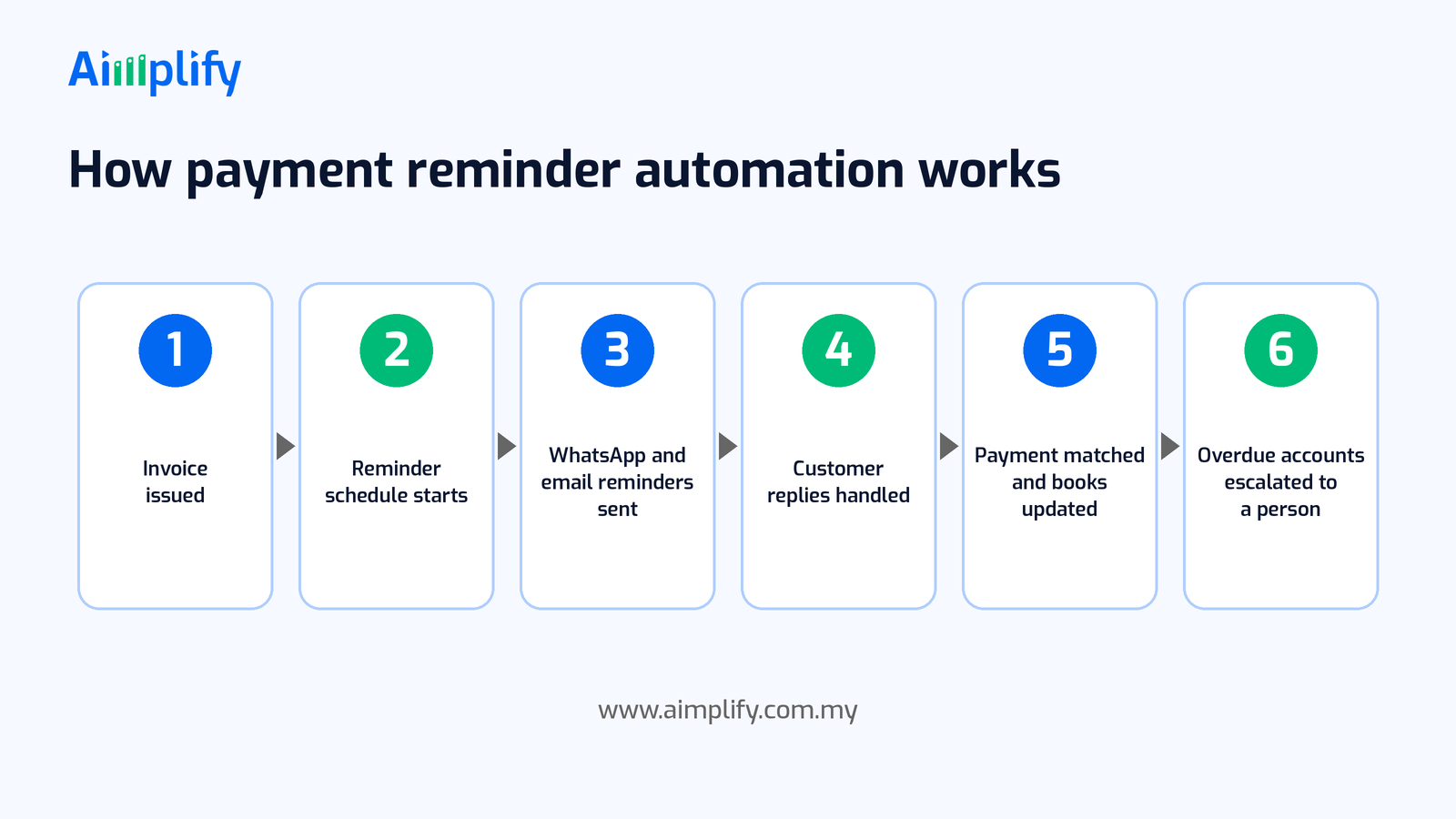
How an Automated Payment Reminder Workflow Works
Here is what a typical automated collection flow looks like for a small Malaysian business.
- Invoice issued. An invoice is created in your accounting software, or sent to the agent to record. This starts the workflow.
- Reminder schedule starts. The agent sets the reminder dates based on the invoice's payment terms and your rules for that customer.
- Reminders sent. Polite reminders go out by WhatsApp or email before and after the due date, each one quoting the invoice number, amount and due date.
- Replies handled. The agent answers routine questions, resends invoices, records promised payment dates and routes disputes to a person.
- Payment matched and books updated. When payment arrives, the agent matches it to the invoice, updates your records and stops the reminders.
- Exceptions escalated. Accounts that stay overdue, partial payments and anything unusual are handed to the owner or accounts team with the full history attached.
Keep the Tone Right and Humans in Control
Collections touch customer relationships, so automation has to be set up with care.
Write the messages once, carefully. Agree on wording for each stage: friendly before the due date, clear on the due date, firmer but still courteous after it. The agent uses those approved templates, so every customer is treated consistently and politely.
Respect customer preferences and channels. Message customers on the channel they have agreed to use, at business hours. If you use WhatsApp for business messaging, follow WhatsApp's business messaging policies and use opt-in contacts. Our guide on why WhatsApp numbers get banned in Malaysia explains what to avoid.
Protect personal data. Customer contact details and payment information are personal data under Malaysia's Personal Data Protection Act 2010 (PDPA). Collect only what you need, store it securely and agree with your provider on how data is handled.
Keep decisions with people. The agent reminds, records and matches. People decide on payment plans, discounts, write-offs, stopping supply or any formal legal step, which should always be handled with your own adviser.
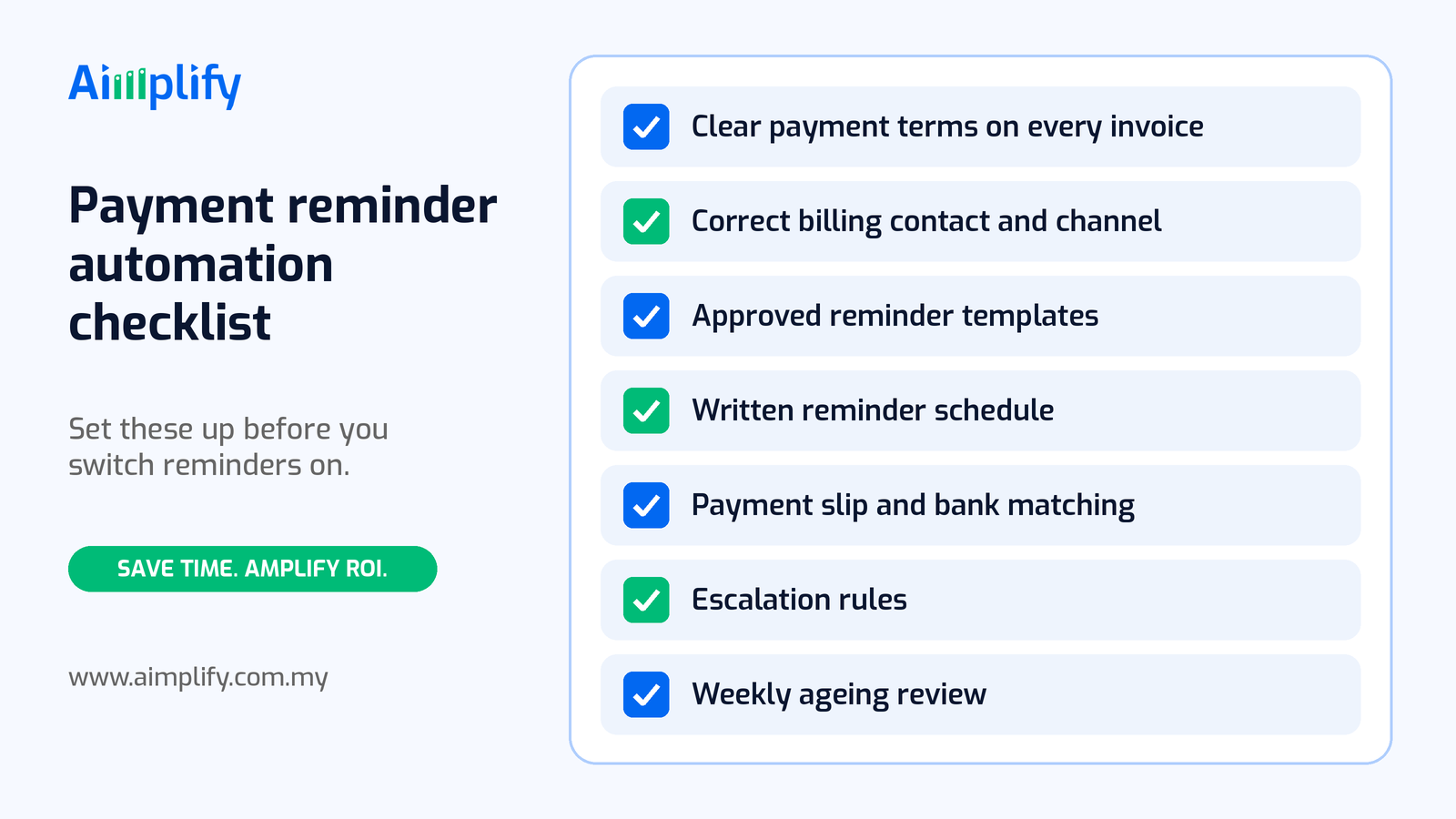
A Payment Reminder Checklist You Can Start With
If you are not ready to automate yet, start by standardising. A simple checklist for Malaysian SMEs:
- Clear payment terms and due dates on every invoice
- The correct billing contact and preferred channel for each customer
- Approved reminder templates for before, on and after the due date
- A written reminder schedule that everyone follows
- A process for matching payment slips and bank credits to invoices
- Escalation rules: when the owner or account manager steps in
- A weekly look at the ageing list
Once this is written down, it becomes the script your AI accounting agent follows, and the standard your collections are measured against.
Where Aimplify Accounting Fits
Aimplify Accounting is an autonomous AI agent for the finance admin that slows Malaysian SMEs down. It extracts data from receipts and invoices, generates invoices, logs expenses, sends payment reminders and posts into your accounting system, including SQL Accounting.
Payment reminders work best when the rest of the finance workflow is clean. If invoices and receipts are still keyed in by hand, start with our guides to SQL Accounting invoice automation and month-end receipt automation. Accounting firms managing collections for many clients may also find our post on AI for accounting firms in Malaysia useful.
We do not ask you to rip out your current accounting software. Data cleaning and integration with tools such as WhatsApp, email, Google Sheets, cloud drives and your existing accounting system are part of the setup, and our 28-day AI implementation plan shows how we take a workflow from bottleneck to go-live. Customer questions that are not about payment can be handled by Aimplify CS.
Ready to hire your AI workforce? Book a live demo or talk to an AI architect about automating payment reminders in your business.
Frequently Asked Questions
What is payment reminder automation?
Payment reminder automation uses software to send reminders for unpaid invoices on a set schedule, handle routine replies, match payments to invoices and update your records. Your team still decides on payment plans, disputes and escalation, but no longer has to remember who to chase and when.
Can I send payment reminders through WhatsApp in Malaysia?
Yes. Many Malaysian businesses already talk to customers on WhatsApp, and an AI agent can send reminders there using approved wording at business hours. Message only customers who have agreed to be contacted, follow WhatsApp's business messaging policies and handle data in line with the PDPA.
Will automated reminders annoy my customers?
Not if the schedule and wording are set well. Reminders should be courteous, accurate and spaced out, and should stop as soon as payment arrives. Consistent, polite reminders are usually less awkward than a sudden call weeks after the due date.
Does it work with my accounting software?
An AI accounting agent can work with the tools you already use, such as SQL Accounting, Google Sheets, email and WhatsApp. The goal is to connect your existing system, read open invoices from it and record payments back into it, not to replace it.
What happens when a customer still does not pay?
The agent escalates the account to the owner or account manager with the full reminder and reply history. People then decide the next step, such as a call, a payment plan or stopping further supply. Any formal legal action should be handled with your own adviser.
Related Articles
Lead Follow-Up Automation Malaysia: Reply on WhatsApp Fast
Lead follow-up automation in Malaysia helps SMEs reply to every WhatsApp enquiry fast, qualify leads, send timely follow-ups and pass hot leads to sales.
AI WorkforcePayroll Automation Malaysia: Faster, Accurate Pay Runs
Payroll automation in Malaysia helps SMEs gather attendance, leave and claims, prepare EPF, SOCSO, EIS and PCB, and run accurate pay without spreadsheets.
AI WorkforceAppointment Booking Automation Malaysia: Book on WhatsApp
Appointment booking automation in Malaysia lets SMEs take bookings on WhatsApp 24/7, confirm slots, send reminders and handle changes without extra admin.